Haggling at a Market in Spanish: Phrases That Get You a Deal
Learn how to haggle at a market in Spanish: phrases to ask the price, bargain politely and close the deal, plus a mini dialogue, a quiz and a phrase cheat sheet.
Nativia Team
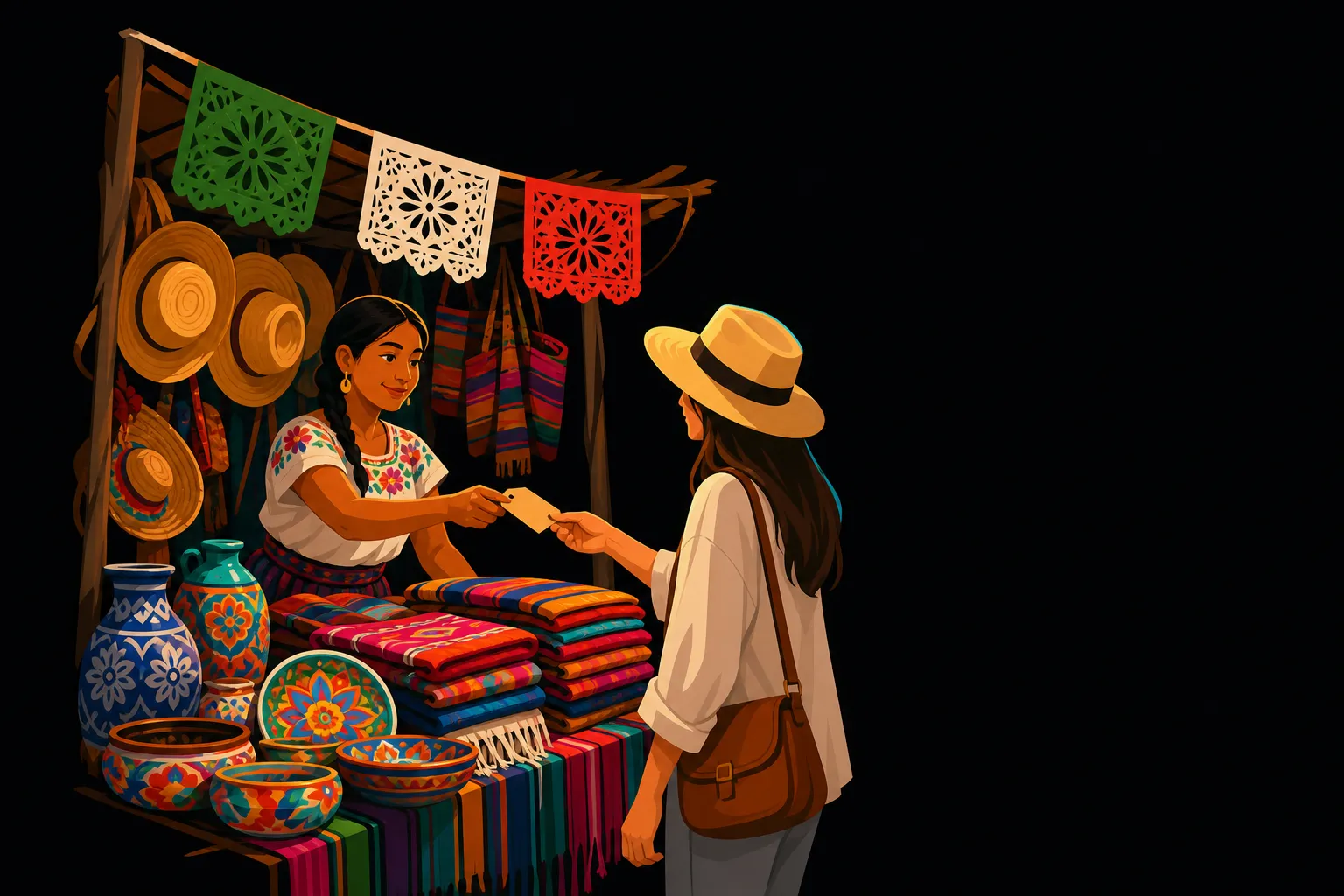
The first time I tried to buy a blanket at a market in Oaxaca, I paid the first price the vendor said, in cash, without a word. She looked almost disappointed. Haggling is not rude there. It is a conversation, and the vendor expects you to join it.
This guide walks you through that conversation from the moment you stop at a stall to the moment you walk away with a bag in your hand. You get the phrases, what the vendor will say back, and how to answer without sounding like a tourist reading from a phone.
Quiz ahead: At the end there is a short quiz that puts you in front of a vendor. Question 4 catches almost everyone.Step 1: Ask the price without committing
Do not point and say ¿Cuánto? (How much?) with a blank face. Pick the item up, look at it, and ask like you have all afternoon.
- ¿Cuánto cuesta esto? (How much does this cost?)
- ¿A cómo está el kilo? (How much is the kilo?) for fruit, cheese, coffee
- ¿Y este, cuánto vale? (And this one, how much is it worth?)
The vendor will answer with a number and often a little pitch: Trescientos, pero es hecho a mano. (Three hundred, but it is handmade.) Your job now is to react, not to accept.
Step 2: React and open the negotiation
The reaction matters more than the number. A soft surprised face and one of these lines tells the vendor you know the game.
- Uy, está un poco caro. (Oof, that is a bit expensive.)
- ¿Es su mejor precio? (Is that your best price?)
- ¿Me lo puede dejar más barato? (Can you give it to me cheaper?)
The vendor will usually come back with ¿Cuánto me ofrece? (How much do you offer me?) or ¿Cuánto quiere pagar? (How much do you want to pay?). Now you name a number, and here is the trick: start around 60 to 70 percent of the asking price, said with a smile.
- Le doy doscientos. (I will give you two hundred.)
- ¿Qué tal doscientos veinte? (How about two hundred twenty?)

Reading is step one. Speaking is what makes it stick.
Practice this in a real conversation, with instant feedback.
Step 3: The back and forth
Expect one or two counter offers. The vendor might say No, mire, a doscientos cincuenta se lo dejo. (No, look, I will leave it to you at two hundred fifty.) You can meet in the middle or use the two strongest tools you have: buying more, or walking.
- Si me llevo dos, ¿me hace un descuento? (If I take two, will you give me a discount?)
- Está bien, lo voy a pensar. Gracias. (Okay, I will think about it. Thanks.)
Saying you will think about it and actually turning away is the classic move. Half the time you hear Bueno, bueno, doscientos treinta y ya. (Fine, fine, two hundred thirty and that is it.) before you take three steps.
Step 4: Close the deal
Once the number feels right, close warmly. Vendors remember rude bargainers and generous ones alike.
- Va, me lo llevo. (Deal, I will take it.)
- Trato hecho. (It is a deal.)
- ¿Me lo puede envolver, por favor? (Can you wrap it for me, please?)
Then the money. Ask ¿Acepta tarjeta? (Do you take cards?) before you assume, because most stalls are cash only. And if you only have a big bill: ¿Tiene cambio de quinientos? (Do you have change for five hundred?)
Key takeaway:
- React to the first price out loud, never in silence.
- Offer a real number, not just "cheaper," and let buying more or walking away do the work.
- Close with a thank you and a smile. You will get better prices at that stall next time.
Don't just memorize it. Say it out loud today.
Nativia turns what you just read into real conversations.
Mini dialogue: buying a hammock
Tú: Buenas, ¿cuánto cuesta esta hamaca? (Hi, how much is this hammock?)
Vendedora: Cuatrocientos. Es de algodón, mire qué suave. (Four hundred. It is cotton, look how soft.)
Tú: Uy, está un poco caro. ¿Es su mejor precio? (Oof, that is a bit expensive. Is that your best price?)
Vendedora: ¿Cuánto me ofrece? (How much do you offer me?)
Tú: Le doy doscientos ochenta. (I will give you two hundred eighty.)
Vendedora: No, mire, a trescientos cincuenta se la dejo. (No, look, I will leave it to you at three hundred fifty.)
Tú: Trescientos y me la llevo ahorita. (Three hundred and I will take it right now.)
Vendedora: Bueno, trescientos. Trato hecho. (Fine, three hundred. Deal.)
Tú: Gracias. ¿Tiene cambio de quinientos? (Thanks. Do you have change for five hundred?)
Notice the buyer never insulted the product or the price. Every line kept the door open.
Self-test: you are at the stall
Pick what you would actually say at each moment, then check your answers.
You are at a craft market. Choose the best reply or the missing word at each moment.
1.You pick up a bag and want the price. What do you say?
2.The vendor says 300. You want to open the negotiation politely: Uy, está un poco .
Oof, that is a bit expensive.
3.The vendor asks: ¿Cuánto me ofrece? What do you reply?
4.You want a discount for buying two: Si me llevo dos, ¿me un descuento?
If I take two, will you give me a discount?
5.You both agreed on 250. How do you close?
6.You only have a big bill. What do you ask?
Market haggling cheat sheet
Haggling at a market in Spanish
| Moment | Spanish | English |
|---|---|---|
| Ask the price | ¿Cuánto cuesta esto? | How much does this cost? |
| Ask a price per kilo | ¿A cómo está el kilo? | How much is the kilo? |
| React | Uy, está un poco caro. | Oof, that is a bit expensive. |
| Ask for the best price | ¿Es su mejor precio? | Is that your best price? |
| Ask for cheaper | ¿Me lo puede dejar más barato? | Can you give it to me cheaper? |
| Vendor asks your offer | ¿Cuánto me ofrece? | How much do you offer me? |
| Make an offer | Le doy doscientos. | I will give you two hundred. |
| Counter offer | ¿Qué tal doscientos veinte? | How about two hundred twenty? |
| Bulk discount | Si me llevo dos, ¿me hace un descuento? | If I take two, will you give me a discount? |
| Walk away | Lo voy a pensar, gracias. | I will think about it, thanks. |
| Close the deal | Va, me lo llevo. | Deal, I will take it. |
| Seal it | Trato hecho. | It is a deal. |
| Ask about cards | ¿Acepta tarjeta? | Do you take cards? |
| Ask for change | ¿Tiene cambio de quinientos? | Do you have change for five hundred? |
| Ask for wrapping | ¿Me lo puede envolver? | Can you wrap it for me? |
Rehearse this exact situation before it happens
Play the scene in Nativia as often as you like, so the right words are there when you need them for real.
Keep reading
Checking Into a Hotel in Spanish: Phrases That Work
Learn the exact Spanish phrases for hotel check-in, from the reservation to the room key, plus what the receptionist says back and a free cheat sheet.
At the Pharmacy in Spanish: Phrases for When You Feel Sick
Learn the Spanish you need at the pharmacy: describe your symptoms, understand the pharmacist's questions, and get the right medicine with confidence.
7 Ways You Sound Rude in Spanish Without Meaning To
Common Spanish politeness mistakes English speakers make: quiero, tú vs usted, lo siento, ¿qué? and more. Fix each one with a memory hook and a self-test.