At the Pharmacy in Spanish: Phrases From Symptom to Dosage
Learn the Spanish pharmacy phrases you need: describe symptoms, ask for medicine, understand dosage instructions, plus a dialogue, quiz and cheat sheet.
Nativia Team
Nobody plans to learn pharmacy Spanish. You learn it at 9 pm in Oaxaca with a fever, pointing at your throat while the pharmacist asks you three questions you do not understand. I have been that person. This guide walks you through the whole visit in order, so the next time your stomach turns on you in Spain or Latin America, you know what to say and what is coming back at you.
Quiz ahead: At the end of this article a short quiz puts you behind the pharmacy counter. Question 4 catches almost everyone.Finding the Pharmacy
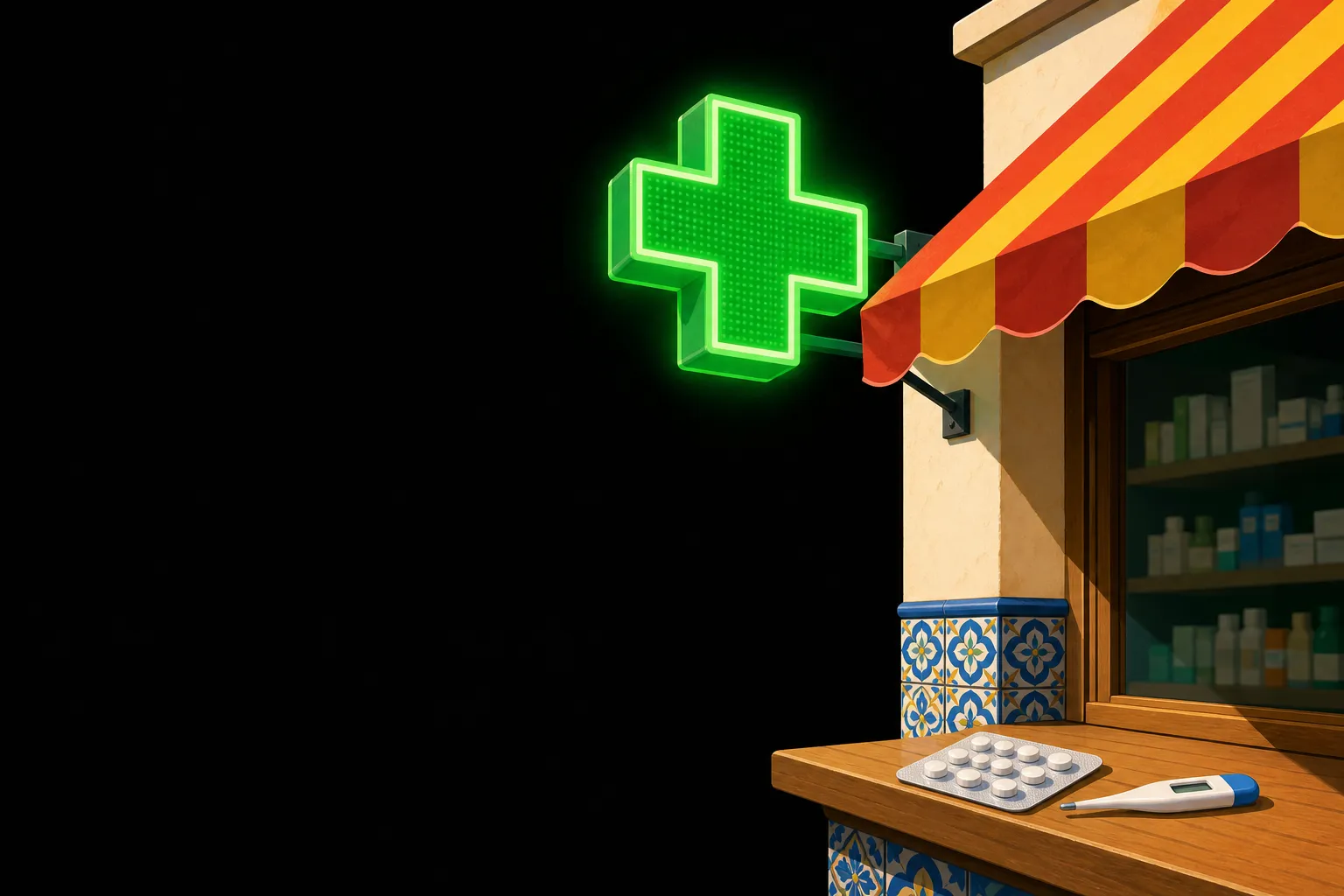
Look for the green cross. In most Spanish-speaking countries pharmacies are small, independent and everywhere. If it is late, you need the one on night duty.
¿Dónde hay una farmacia? (Where is there a pharmacy?)
¿Hay una farmacia de guardia cerca? (Is there an on-duty pharmacy nearby?)
In Mexico you will also hear farmacia de 24 horas (24-hour pharmacy). Many chains there have a doctor's office attached, which is handy when a pharmacist is not enough.
Step 1: Say What Hurts
Spanish does not say "my head hurts." It says "the head hurts me." Memorize the pattern me duele plus a body part, and swap the part.
Me duele la cabeza. (My head hurts.)
Me duele la garganta. (My throat hurts.)
Me duele el estómago. (My stomach hurts.)
For plural body parts, switch to me duelen: Me duelen los oídos. (My ears hurt.) For symptoms that are not pain, use tengo:
Tengo fiebre. (I have a fever.)
Tengo tos y mocos. (I have a cough and a runny nose.)
Tengo diarrea desde ayer. (I have had diarrhea since yesterday.)
Estoy resfriado. (I have a cold.) Women say resfriada.
The pharmacist will ask back:
¿Desde cuándo? (Since when?) Answer with desde ayer (since yesterday) or desde hace dos días (for two days).
¿Es para usted? (Is it for you?) Reply Sí, para mí (Yes, for me) or No, para mi hijo (No, for my son).

Reading is step one. Speaking is what makes it stick.
Practice this in a real conversation, with instant feedback.
Step 2: Ask for Something
You do not need the brand name. Describe the problem and let them recommend.
¿Tiene algo para el dolor de cabeza? (Do you have something for a headache?)
Necesito algo para la tos. (I need something for a cough.)
¿Qué me recomienda? (What do you recommend?)
¿Necesito receta? (Do I need a prescription?)
Common things you might ask for by name: paracetamol, ibuprofeno, tiritas (plasters, Spain) or curitas (Latin America), protector solar (sunscreen), repelente de mosquitos (mosquito repellent), pastillas para el mareo (motion sickness pills).
The pharmacist's follow-up questions are predictable:
¿Prefiere pastillas o jarabe? (Do you prefer tablets or syrup?)
¿Toma algún otro medicamento? (Are you taking any other medication?)
¿Es alérgico a algo? (Are you allergic to anything?) Say Soy alérgico a la penicilina (I am allergic to penicillin) or No, a nada (No, to nothing).
Step 3: Understand the Dosage
This is the part that matters, and the part most people nod through without understanding. Ask directly:
¿Cómo lo tomo? (How do I take it?)
¿Cada cuántas horas? (Every how many hours?)
Then listen for these answers:
Una cada ocho horas. (One every eight hours.)
Dos veces al día, después de comer. (Twice a day, after meals.)
No más de tres al día. (No more than three a day.)
En ayunas. (On an empty stomach.)
Durante cinco días. (For five days.)
If you did not catch it, say ¿Me lo puede escribir? (Can you write it down for me?). Every pharmacist will. The box also comes with a prospecto (information leaflet), which is dense but reliable.
Don't just memorize it. Say it out loud today.
Nativia turns what you just read into real conversations.
Step 4: Pay and Double-Check
¿Cuánto es? (How much is it?)
¿Hay genérico? (Is there a generic?) Generics are often half the price and pharmacists rarely offer them unprompted.
¿Tiene efectos secundarios? (Does it have side effects?)
¿Puedo tomar alcohol con esto? (Can I drink alcohol with this?) Not glamorous, but on a trip it is the question people actually have.
Key takeaway:
- Me duele plus a body part covers pain. Tengo plus a noun covers everything else.
- Receta means prescription here. Nobody is asking you for a cooking recipe.
- Always confirm cada cuántas horas before you leave the counter.
Mini Dialogue
You walk in with a sore throat and a cough.
Tú: Buenas. Me duele la garganta y tengo tos desde hace dos días. (Hi. My throat hurts and I have had a cough for two days.)
Farmacéutica: ¿Tiene fiebre? (Do you have a fever?)
Tú: Un poco, creo. ¿Qué me recomienda? (A little, I think. What do you recommend?)
Farmacéutica: Le doy unas pastillas para la garganta y un jarabe para la tos. ¿Es alérgico a algo? (I will give you some throat lozenges and a cough syrup. Are you allergic to anything?)
Tú: No, a nada. ¿Cómo tomo el jarabe? (No, to nothing. How do I take the syrup?)
Farmacéutica: Una cucharada tres veces al día, después de comer. (One spoonful three times a day, after meals.)
Tú: Perfecto. ¿Cuánto es? (Perfect. How much is it?)
This is roughly the exchange I practiced on repeat in a Nativia pharmacy scenario before a trip to Colombia. The real pharmacist said almost exactly these lines, which was mildly spooky.
Test Yourself
You are at the counter. Pick what you would say or how you would reply.
Choose the best option at each moment of the pharmacy visit, then check your answers.
1.Your ears hurt. You say: Me los oídos.
My ears hurt.
2.The pharmacist asks: ¿Desde cuándo? What do you reply?
3.You want to know if you need a prescription. You ask: ¿Necesito ?
Do I need a prescription?
4.In Madrid you tell the pharmacist: Estoy constipado. What did you just say?
5.The pharmacist says: Una cada ocho horas, no más de tres al día. How many pills can you take per day at most?
6.You did not understand the dosage. Which sentence asks them to write it down?
Pharmacy Cheat Sheet
At the pharmacy in Spanish
| Moment | Spanish | English |
|---|---|---|
| Finding it | ¿Hay una farmacia de guardia cerca? | Is there an on-duty pharmacy nearby? |
| Pain | Me duele la cabeza / la garganta / el estómago. | My head / throat / stomach hurts. |
| Pain, plural | Me duelen los oídos. | My ears hurt. |
| Symptoms | Tengo fiebre / tos / diarrea / náuseas. | I have a fever / a cough / diarrhea / nausea. |
| Cold | Estoy resfriado. (Spain also: constipado) | I have a cold. |
| Since when | Desde ayer. / Desde hace dos días. | Since yesterday. / For two days. |
| Asking | ¿Tiene algo para el dolor de cabeza? | Do you have something for a headache? |
| Asking | ¿Qué me recomienda? | What do you recommend? |
| Prescription | ¿Necesito receta? | Do I need a prescription? |
| Allergies | Soy alérgico a la penicilina. / No, a nada. | I am allergic to penicillin. / No, to nothing. |
| Dosage | ¿Cómo lo tomo? ¿Cada cuántas horas? | How do I take it? Every how many hours? |
| Dosage reply | Una cada ocho horas, después de comer. | One every eight hours, after meals. |
| Dosage reply | En ayunas. / Durante cinco días. | On an empty stomach. / For five days. |
| Clarify | ¿Me lo puede escribir? | Can you write it down for me? |
| Paying | ¿Hay genérico? ¿Cuánto es? | Is there a generic? How much is it? |
| Safety | ¿Tiene efectos secundarios? | Does it have side effects? |
Rehearse this exact situation before it happens
Play the scene in Nativia as often as you like, so the right words are there when you need them for real.
FAQ
Can I buy antibiotics without a prescription in Latin America?
Officially no in most countries, including Mexico since 2010. In practice rules vary by country and by pharmacy. Ask ¿Necesito receta? and accept the answer. Many Mexican pharmacy chains have a consultorio next door where a doctor can write one for a few dollars.
What is the difference between farmacia and droguería?
In Spain a droguería sells cleaning products and toiletries, not medicine. In Colombia a droguería is a normal pharmacy. When in doubt, follow the green cross or just ask for una farmacia.
How do I say "over the counter" in Spanish?
Sin receta (without prescription). Ask ¿Lo venden sin receta? (Do you sell it without a prescription?) and the pharmacist will tell you.
Keep reading
Buying a SIM Card in Spanish: Phrases From Counter to Signal
Buying a SIM card in Spanish made simple: the phrases to ask for a prepaid plan, hand over your passport, pick data, and get your number working, plus a quiz.
Ordering at a Restaurant in Spanish: Phrases From Table to Bill
Ordering at a restaurant in Spanish, step by step: getting a table, ordering food and drinks, asking for the bill, and what the waiter will say back.
Taking a Taxi in Spanish: Phrases From Pickup to Paying
The Spanish taxi phrases you actually need: hailing a cab, giving an address, agreeing on the price, and paying without getting overcharged.