Qué vs Cuál: When Spanish Has Two Words for 'What'
Qué vs cuál confuses every English speaker because both mean what or which. Learn the real rule, the noun trap, and test yourself with a short quiz.
Nativia Team
English has one lazy word, "what", and it covers everything from "what is love" to "what is your name". Spanish splits that job between qué and cuál, and the split does not follow English at all. That is why so many learners ask ¿Qué es tu nombre? and get a confused look back.
Quiz ahead: A short quiz at the end of this article tests all of this. Question 4 catches almost everyone.Qué: open answers and definitions
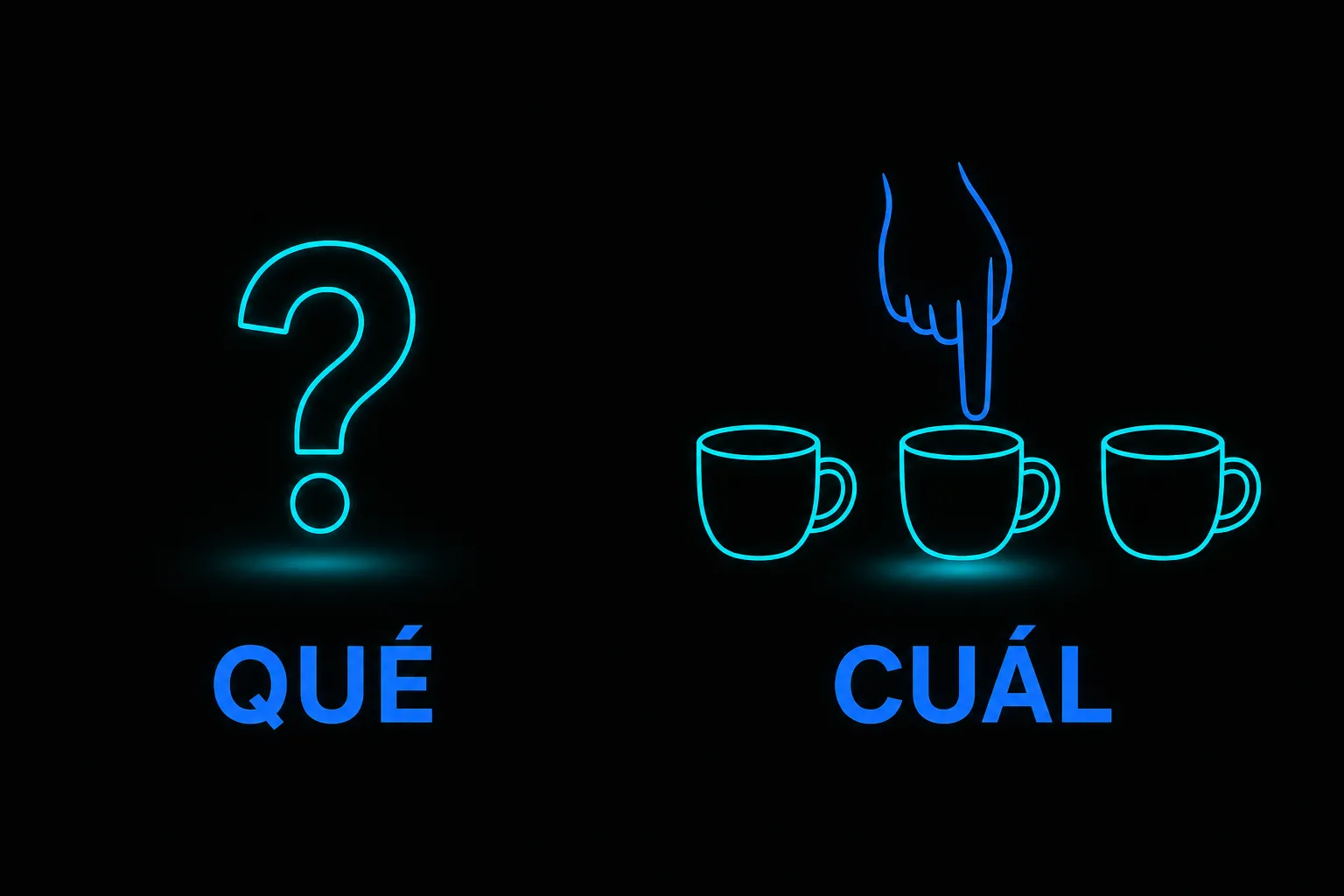
Use qué when the answer is wide open or when you want a definition. There is no list to pick from. You are asking "what kind of thing is this?" or "what, out of everything?"
¿Qué es el mate? (What is mate?) ¿Qué quieres hacer esta noche? (What do you want to do tonight?) ¿Qué significa "chamba"? (What does "chamba" mean?)
Qué also sits directly in front of nouns. This is the one rule that never bends: if a noun follows, use qué, even when English would say "which".
¿Qué libro estás leyendo? (What book are you reading?) ¿Qué línea de metro va al aeropuerto? (Which metro line goes to the airport?)
Cuál: picking from a set
Use cuál when there is a group of possibilities, spoken or implied, and you want one of them. The answer is a specific item, name, number, or choice, not an explanation.
¿Cuál es tu número de teléfono? (What is your phone number?) ¿Cuál de estos vinos me recomiendas? (Which of these wines do you recommend?) Tengo dos entradas. ¿Cuál quieres? (I have two tickets. Which one do you want?)
When the group has more than one answer, it becomes cuáles.
¿Cuáles son tus planes para el finde? (What are your plans for the weekend?)
Key takeaway:
- Qué asks for a definition or an open answer, and it always goes before a noun.
- Cuál picks one item out of a set, and it goes before ser, before de, or stands alone.

Reading is step one. Speaking is what makes it stick.
Practice this in a real conversation, with instant feedback.
The ser test
Almost every real-life mistake happens in front of ser. In English both "What is your address?" and "What is an address?" use the same word. Spanish hears them as two different questions.
¿Qué es una dirección? (What is an address? Explain the concept to me.) ¿Cuál es tu dirección? (What is your address? Give me yours out of all possible addresses.)
So before ser, ask yourself: do I want a definition, or do I want a specific one? Definition means qué. Specific one means cuál. Name, age, email, favorite anything, capital city, difference between two things: all cuál.
¿Cuál es la capital de Perú? (What is the capital of Peru?) ¿Cuál es la diferencia entre "ser" y "estar"? (What is the difference between "ser" and "estar"?)
Common traps
Cuál plus a noun. In Mexico, Colombia and a few other places you will hear ¿Cuál camisa te gusta? in everyday speech. It is understood, but it is regional, and in Spain it sounds off. ¿Qué camisa te gusta? works everywhere, so make it your default.
Exclamations. Only qué works here. ¡Qué calor! (It's so hot!) and ¡Qué rico! (So tasty!) never take cuál.
After prepositions. The same logic applies. ¿De qué hablas? (What are you talking about?) is open. ¿Con cuál te quedas? (Which one are you keeping?) is a choice.
Cuál as "which one" on its own. English needs the word "one". Spanish does not. ¿Cuál? already means "which one?". Adding uno sounds like a translation.
Don't just memorize it. Say it out loud today.
Nativia turns what you just read into real conversations.
Test yourself
Pick the right word in each sentence, then check your answers.
Choose qué or cuál, or pick the correct sentence, then check your answers.
1.¿ es tu correo electrónico?
What is your email address?
2.¿ película vemos esta noche?
Which movie are we watching tonight?
3.A friend asks what the word 'guagua' means in Cuba. Which question did they ask?
4.¿ es la capital de Colombia?
What is the capital of Colombia?
5.Hay tres postres. ¿ quieres?
There are three desserts. Which one do you want?
6.Which sentence is correct everywhere in the Spanish-speaking world?
Qué vs cuál cheat sheet
Qué vs cuál at a glance
| Situation | Word | Example |
|---|---|---|
| Asking for a definition | qué | ¿Qué es el mate? (What is mate?) |
| Open question with a verb | qué | ¿Qué quieres hacer? (What do you want to do?) |
| Directly before a noun | qué | ¿Qué libro lees? (What book are you reading?) |
| Exclamations | qué | ¡Qué calor! (It's so hot!) |
| Specific info before ser: name, number, address | cuál | ¿Cuál es tu nombre? (What is your name?) |
| Choosing from a set | cuál | ¿Cuál quieres? (Which one do you want?) |
| Choosing with de | cuál de | ¿Cuál de estos? (Which of these?) |
| More than one answer expected | cuáles | ¿Cuáles son tus planes? (What are your plans?) |
Practice this grammar in real conversations
Rules only stick when you use them. Practice them in real conversations in Nativia and get instant grammar feedback after every message.
FAQ
Is "¿Qué es tu nombre?" ever correct?
No. A name is a specific item from a set, so it is always ¿Cuál es tu nombre? The only time ¿Qué es...? fits is when you want someone to explain what a thing is.
Can I say "¿Cuál uno?" for "which one?"
Avoid it. ¿Cuál? already means "which one?" on its own. Adding uno is a direct translation from English and marks you as a learner instantly.
Why do Mexicans say "¿Cuál libro?" if the rule says "qué" before nouns?
Spoken Latin American Spanish, especially in Mexico and parts of the Caribbean, allows cuál before a noun. It is natural there and understood everywhere, but qué before a noun is accepted in every country and in writing, so it is the safer habit.
Keep reading
Qué vs Cuál: When to Use Each 'What' in Spanish
Qué vs cuál confuses almost every English speaker. Learn the one test that decides it, the traps around 'es', and check yourself with a short quiz.
Saber vs Conocer: Two Ways to Say 'Know' in Spanish
Saber vs conocer explained with real examples, the traps that catch English speakers, a quick self-test and a downloadable cheat sheet for Spanish learners.
Ser vs Estar: The Spanish Rule Nobody Explained to You
Ser vs estar finally explained: when Spanish uses each verb for 'to be', the common traps like aburrido and listo, a quick self-test and a cheat sheet.