Por vs Para: The Spanish Rule That Finally Makes Sense
Por vs para explained the way learners actually get it: one mental model, real examples, common traps, a quick self-test and a downloadable cheat sheet.
Nativia Team
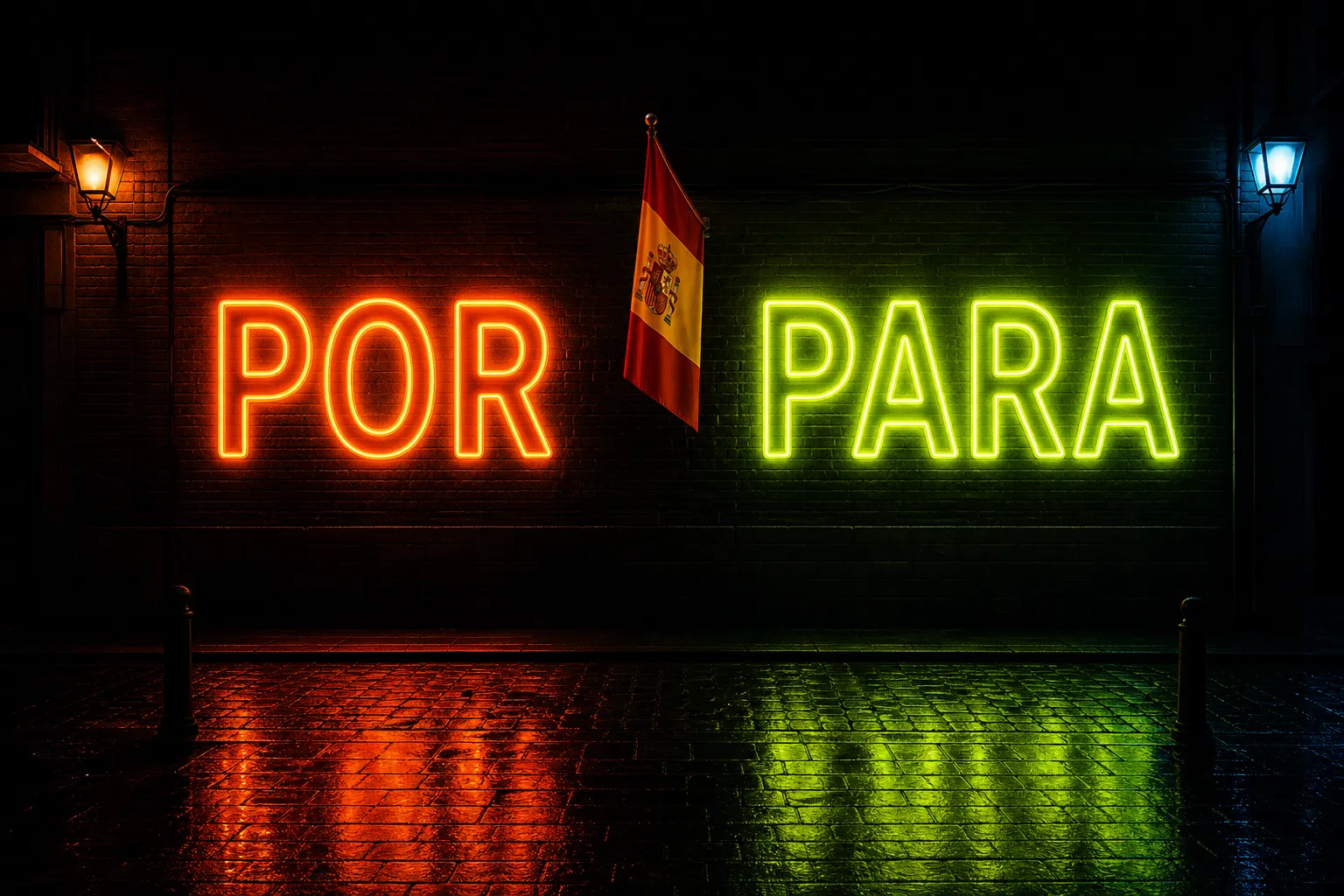
English has one word, "for", and Spanish split it into two. That is the whole problem. You learned "for" as a single idea, so every time you reach for it in Spanish your brain stalls between por and para, and you pick one at random.
The fix is not a list of twenty rules. It is one question: are you pointing at where something ends up, or at what is behind it?
Quiz ahead: A six-question self-test waits at the end of this article. Question 4 fools most learners, even the ones who think they have this down.Para: where it ends up
Para always points forward. It names the endpoint of something: a destination, a goal, a recipient, a deadline, or the person whose opinion you are reporting.
Este regalo es para mi hermana. (This gift is for my sister.) The gift has a human endpoint.
Salgo para Bogotá el viernes. (I'm leaving for Bogotá on Friday.) Bogotá is where the trip ends.
Estudio español para hablar con mi suegra. (I study Spanish in order to talk to my mother-in-law.) The studying has a goal.
Two smaller uses follow the same logic. Deadlines are endpoints in time: Necesito el informe para el lunes. (I need the report by Monday.) And opinions belong to a person: Para mí, el mejor café está en Colombia. (For me, the best coffee is in Colombia.)
Por: what is behind it
Por looks backward or sideways. It names the reason, the route, the exchange, the duration, or the means. Nothing is being aimed at; something is being explained.
Lo hice por ti. (I did it because of you.) You are the reason, not the recipient.
Caminamos por el centro toda la tarde. (We walked through downtown all afternoon.) Movement through a space, not toward a point.
Pagué veinte euros por las entradas. (I paid twenty euros for the tickets.) An exchange: money for tickets.
Duration and means also sit here: Viví en México por dos años. (I lived in Mexico for two years.) Hablamos por teléfono. (We talked by phone.)
Key takeaway:
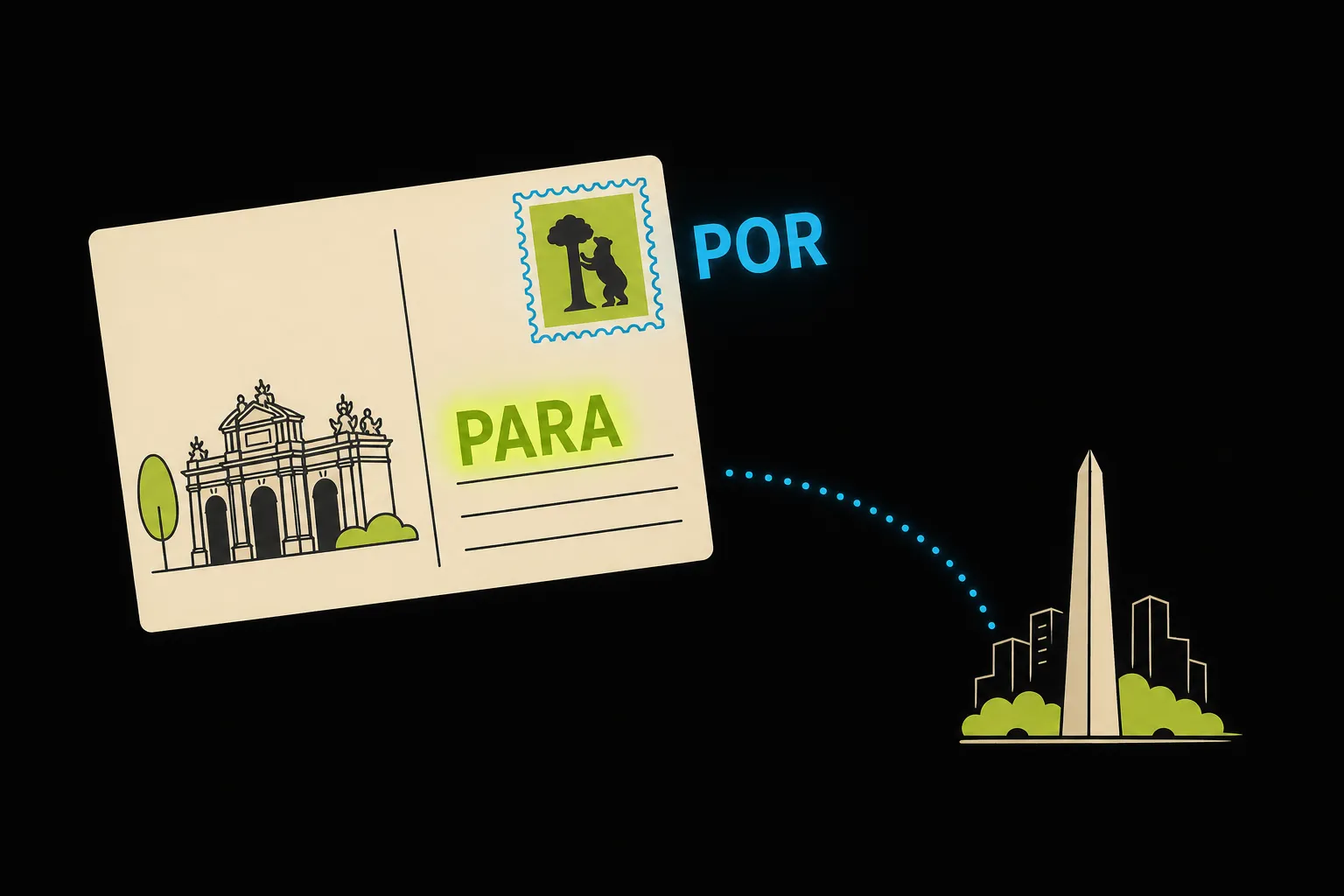
- Para points forward at a destination, goal, recipient, or deadline.
- Por looks at the reason, route, exchange, duration, or means behind something.

Reading is step one. Speaking is what makes it stick.
Practice this in a real conversation, with instant feedback.
Common traps
Most errors happen in three places where the English "for" pulls you the wrong way.
Gratitude and apologies. You thank someone for a reason, so it is always por: Gracias por la ayuda. (Thanks for the help.) Same for perdón por llegar tarde (sorry for being late).
Working for someone. Trabajo para Google means Google is my employer, the endpoint of my work. Trabajo por Google would mean I work on Google's behalf or in their place, which is rarely what you mean.
Times of day. English says "in the morning", Spanish says por la mañana. The morning is not a goal, it is the general stretch of time something happens in.
Then there is the pair that looks like a typo but changes the meaning completely: estar por and estar para. Estoy por salir means I am about to leave, leaning toward it. Estoy para salir means I am ready to leave, everything is set. Latin American speakers use the first one far more.
Watch out:
- Por qué (two words, with accent) asks why. Porque (one word) answers it.
- Por fin (finally), por supuesto (of course) and por ejemplo (for example) are fixed. Do not try to reason them out, just memorize them.
If you want these to stick, say them out loud in a real exchange rather than filling in worksheets. A scenario like ordering tickets or thanking a host, the kind Nativia drops you into, forces the choice under light pressure, which is exactly where the habit forms.
Test yourself
Pick the right option in each sentence, then check your answers.
Choose por or para in each sentence, or pick the correct answer, then check your results.
1.Este vino es mi profesora.
This wine is for my teacher.
2.Gracias venir tan rápido.
Thanks for coming so fast.
3.Which sentence means you are leaving toward Lima?
4.Vendí la bici cien euros.
I sold the bike for a hundred euros.
5.What does Trabajo para una ONG mean?
6.Necesito la respuesta mañana.
I need the answer by tomorrow.
Cheat sheet
Por vs para at a glance
| Idea | Preposition | Example |
|---|---|---|
| Recipient | para | Es para mi hermana. (It's for my sister.) |
| Destination | para | Salgo para Bogotá. (I'm leaving for Bogotá.) |
| Purpose, goal | para | Estudio para hablar. (I study in order to speak.) |
| Deadline | para | Lo necesito para el lunes. (I need it by Monday.) |
| Opinion | para | Para mí, es fácil. (For me, it's easy.) |
| Employer | para | Trabajo para Google. (I work for Google.) |
| Reason, cause | por | Lo hice por ti. (I did it because of you.) |
| Movement through | por | Caminamos por el centro. (We walked through downtown.) |
| Exchange, price | por | Pagué veinte euros por las entradas. (I paid twenty euros for the tickets.) |
| Duration | por | Viví allí por dos años. (I lived there for two years.) |
| Means | por | Hablamos por teléfono. (We talked by phone.) |
| Time of day | por | Por la mañana. (In the morning.) |
| Thanks, apologies | por | Gracias por todo. (Thanks for everything.) |
Practice this grammar in real conversations
Rules only stick when you use them. Practice them in real conversations in Nativia and get instant grammar feedback after every message.
FAQ
Is there a quick trick to remember por vs para?
Ask "for what purpose or for whom?" If the answer is a goal, a person, or a place you are heading to, use para. If the answer is "because of" or "in exchange for", use por. It covers about ninety percent of real sentences.
Why is it "gracias por" and not "gracias para"?
You are thanking someone because of what they did. That is a cause, and causes take por. The same logic gives you perdón por and felicidades por.
Do Spain and Latin America use por and para differently?
The core rules are identical everywhere. The one noticeable difference is estar por, which Latin Americans use for "about to", while Spaniards more often say estar a punto de. Duration is also split: Spain often drops the preposition and says viví allí dos años, while por dos años sounds natural across Latin America.
Keep reading
8 Spanish Preposition Mistakes English Speakers Always Make
Pensar en, depender de, casarse con: 8 Spanish preposition mistakes English speakers make, why each one is wrong, the fix, and a quick self-test.
Por vs Para: How to Finally Choose the Right One
Confused by por vs para? Clear rules, real Spanish example sentences, common traps, and a quick self test to finally pick the right one every time.
8 Spanish Gender Mistakes That Instantly Reveal a Beginner
Spanish gender mistakes like la problema or el mano give you away in seconds. Learn the 8 most common ones, the fixes, and the memory hooks that stick.