Do You Need to Live Abroad to Learn Spanish? 6 Immersion Myths
Think you need to live abroad to learn Spanish? We bust 6 immersion myths with real evidence and show what actually builds fluency from anywhere.
Nativia Team
I spent two years convinced my Spanish was stuck because I lived in the wrong country. Then I met a guy in Guadalajara who had lived there for six years and still ordered tacos in English. Location was clearly not the variable.
Immersion is real and powerful, but most of what people believe about it is folklore. Here are six myths I believed, what the evidence says, and what actually moved my Spanish.
Quiz ahead: At the end of this article a short myth-or-reality quiz tests you. Question 4 fools almost everyone who has studied abroad.Myth 1: You need to live in a Spanish-speaking country to become fluent
Why people believe it: Every fluent person they know has an abroad story, and nobody tells the story of the quiet learner who did it from a kitchen table in Ohio.
What experience shows: Researchers who track study-abroad students find that gains depend on hours of actual interaction, not months on the ground. Students who stayed in English-speaking friend groups improved barely more than students at home. Meanwhile, thousands of learners hit B2 without a passport stamp.
What to do instead: Count speaking minutes, not time zones. Thirty minutes of real conversation a day at home beats a year abroad spent in an expat bubble.
Myth 2: If you listen enough, speaking will come on its own
Why people believe it: It is how babies seem to do it, and listening is comfortable. Nobody judges you while you watch a telenovela.
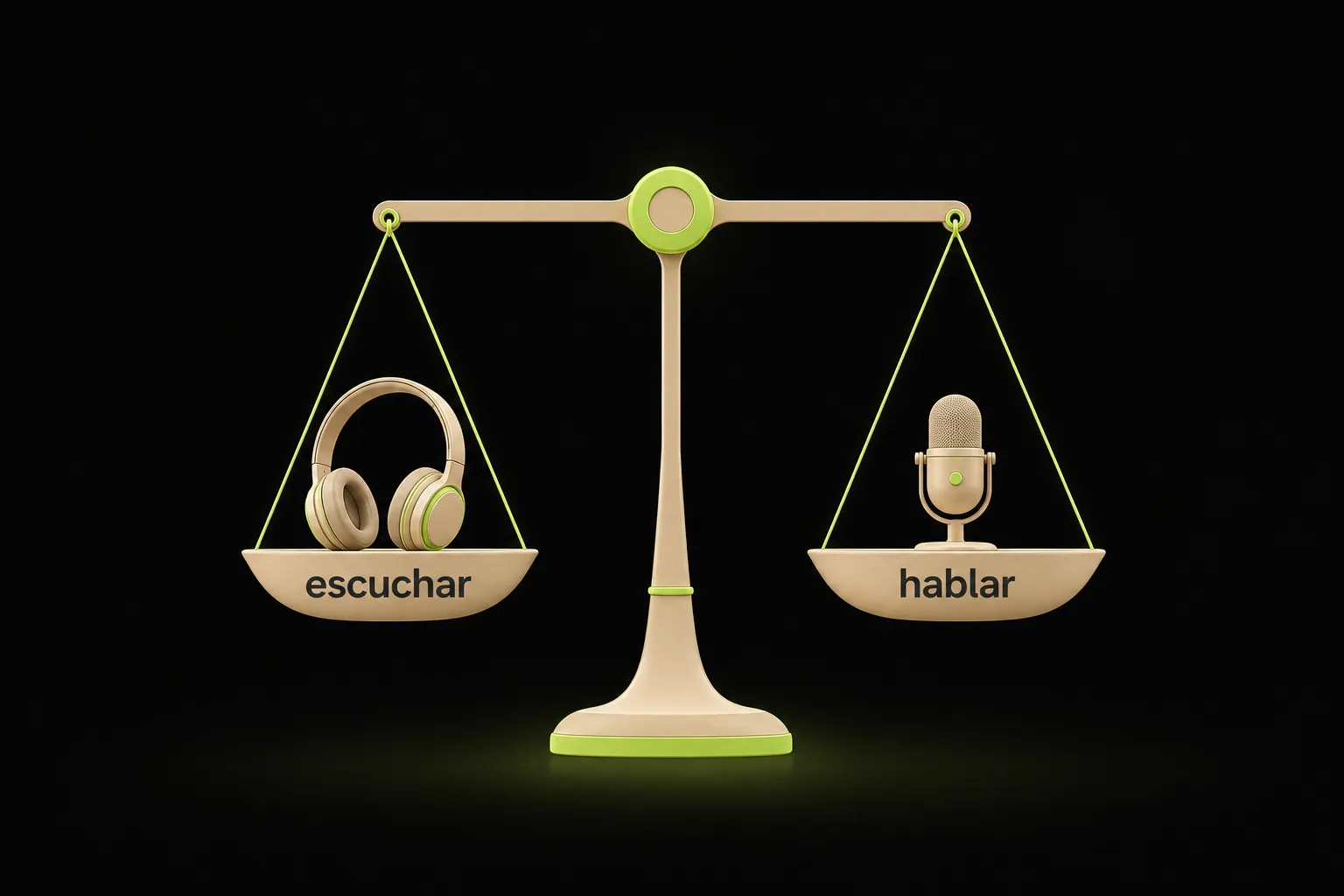
What experience shows: Input builds comprehension. Output builds speech. Linguists call it the output hypothesis: you only discover the gaps in your Spanish when you try to produce a sentence and get stuck. I understood entire podcasts before I could say Creo que nos equivocamos de calle. (I think we took the wrong street.) without freezing.
What to do instead: Pair every listening session with speaking. Retell what you heard, out loud, in your own words, even to an empty room.

Reading is step one. Speaking is what makes it stick.
Practice this in a real conversation, with instant feedback.
Myth 3: Once you arrive, locals will teach you
Why people believe it: Travel blogs promise that friendly natives will patiently correct you over coffee.
What experience shows: Locals are kind, but they are also busy, and many switch to English the moment you hesitate. It is politeness, not a verdict on your level. You have to ask for the practice.
What to do instead: Learn one sentence before you land and use it daily: Prefiero practicar en español, si no te molesta. (I prefer to practice in Spanish, if you don't mind.) Nine times out of ten, they smile and slow down.
Myth 4: A two-week immersion trip is worth months of study
Why people believe it: You come home buzzing. Everything felt easier on day fourteen than on day one.
What experience shows: What improved was mostly confidence and listening speed. Studies on short programs show measurable gains that fade within weeks if practice stops at the airport. The trip is an accelerator, not a destination.
What to do instead: Treat the trip as the middle of a plan. Spend four weeks before it building survival phrases and four weeks after it keeping daily conversation alive.
Don't just memorize it. Say it out loud today.
Nativia turns what you just read into real conversations.
Myth 5: Living abroad fixes your accent automatically
Why people believe it: Children who move abroad end up sounding native, so adults assume exposure does the same for them.
What experience shows: Adults who live abroad for decades often keep a strong accent. Linguists call it fossilization. Once your mouth settles into a pattern that natives understand, nothing pushes it to change unless you work on it deliberately.
What to do instead: Shadow native audio for ten minutes a day and record yourself. Compare your rr in perro (dog) with the original, not with your memory of it.
Myth 6: Conversations with an app or a tutor online don't count as immersion
Why people believe it: It feels less "authentic" than a market in Oaxaca.
What experience shows: Your brain does not check your GPS. It responds to comprehensible input and the pressure to produce language in real time. A ten-minute role play where you have to handle Se nos acabó el pollo, ¿le traigo otra cosa? (We ran out of chicken, shall I bring you something else?) trains the same reflexes as the real restaurant, with far less panic.
What to do instead: Build a daily scenario habit. Apps like Nativia drop you into exactly these moments and give feedback on what you said, which a waiter never will.
Key takeaway:
- Immersion is a quantity of interaction, not a place on a map.
- Passive input never turns into speech without deliberate output.
- Trips and tutors accelerate you only if practice continues afterwards.
Test yourself: myth or reality?
Fresh statements this time. Decide which are myths and which hold up.
Pick Myth or Reality for each statement, then check your answers.
1.Myth or reality: You can reach conversational Spanish without ever leaving your home country.
2.Myth or reality: Watching Spanish shows with English subtitles counts as full immersion.
3.Para pedir que hablen más lento: ¿Puedes hablar más , por favor?
To ask someone to speak slower: Can you speak more slowly, please?
4.Myth or reality: If a local switches to English, it means your Spanish is bad.
5.Myth or reality: Speaking with other learners can still improve your Spanish.
6.Myth or reality: Ten minutes of speaking daily beats one two-hour session on Sunday.
Immersion myths at a glance
Immersion myths vs reality
| Myth | Reality | Do this instead |
|---|---|---|
| You must live abroad to be fluent | Interaction hours matter, not location | Track daily speaking minutes |
| Listening alone leads to speaking | Output builds speech, input builds comprehension | Retell what you hear out loud |
| Locals will teach you | Many switch to English out of politeness | Ask: Prefiero practicar en español |
| Two weeks abroad equals months of study | Gains fade fast without follow-up | Plan 4 weeks before and after the trip |
| Living abroad fixes your accent | Adult accents fossilize without deliberate work | Shadow and record yourself daily |
| Online or app conversations don't count | Your brain responds to real-time pressure, not GPS | Run one scenario conversation per day |
Start speaking today
No excuses left. Download Nativia and have your first real conversation in the next five minutes.
FAQ
Can I really learn Spanish without going abroad?
Yes. The learners who succeed from home replace geography with routine: daily speaking, Spanish-only media, and conversations with natives or an AI partner. Location is a convenience, not a requirement.
How long should I study before an immersion trip?
Aim for at least two to three months of daily practice so you arrive around A2. With survival phrases and basic listening in place, every interaction abroad becomes practice instead of panic.
What is the best way to create immersion at home?
Switch your phone and streaming to Spanish, listen to Spanish podcasts on commutes, and most importantly speak every day. Role-playing realistic scenarios, such as ordering, asking directions or small talk, trains exactly the moments you will face.
Keep reading
Speaking Spanish With Natives: 6 Myths That Keep You Silent
Think natives judge your mistakes or switch to English no matter what? Six myths about speaking Spanish with native speakers, debunked with what really works.
Do You Need to Live Abroad to Speak Spanish? 6 Myths
Myth or reality? Six Spanish immersion myths tested against research and real experience, plus what actually builds speaking fluency from home.
Best Spanish Apps for Pronunciation: Sound Natural, Not Robotic
Which Spanish pronunciation app actually fixes your accent? We compare Pimsleur, Speechling, Rosetta Stone, Duolingo, Babbel and Nativia on speaking time and feedback.